
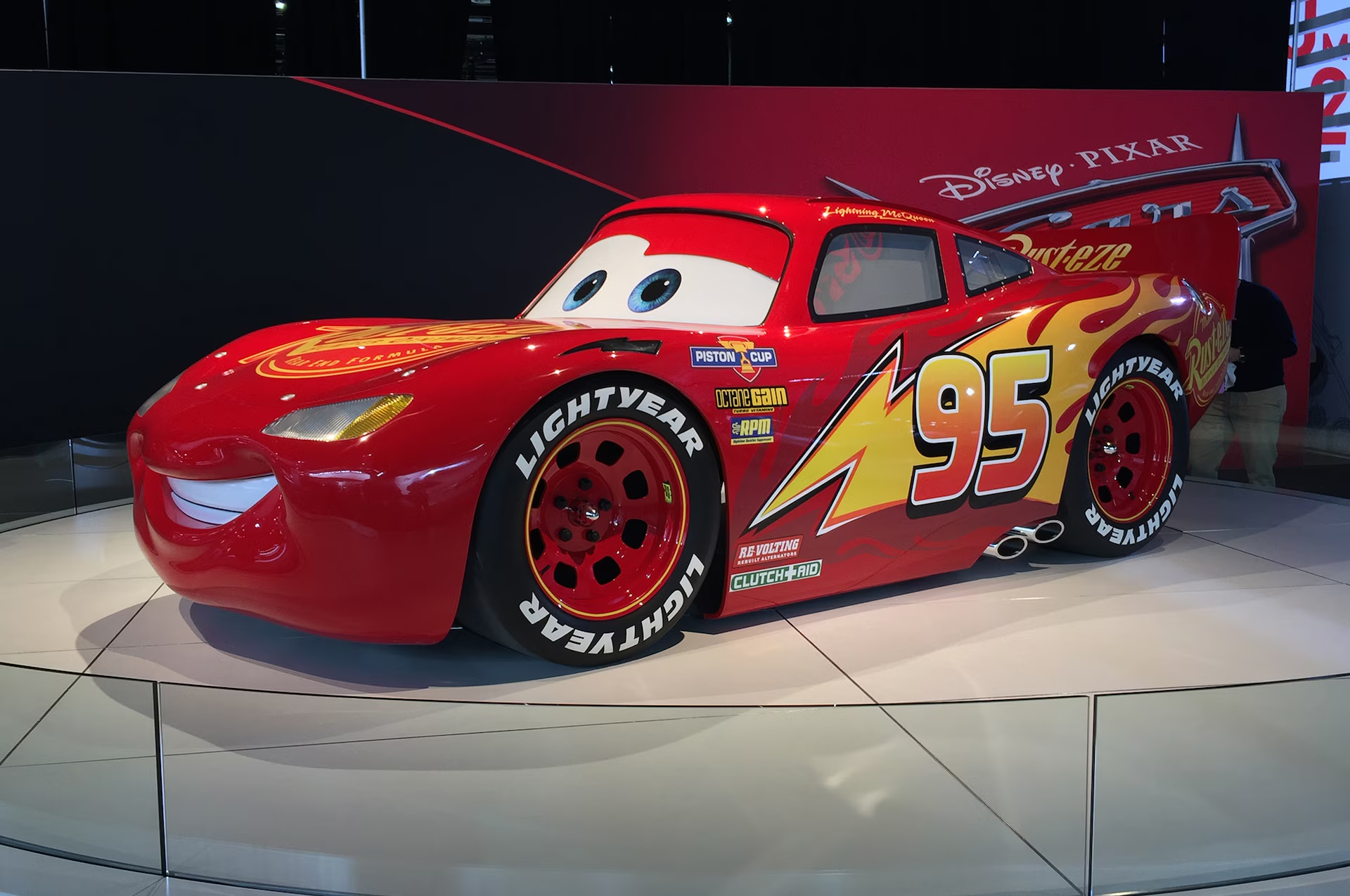

Since his debut in 2006, the ebullient and spirited vehicle from Disney-Pixar’s Cars franchise, Lightning McQueen, has won over millions of hearts. Lightning McQueen has established himself as a legendary figure in contemporary pop culture thanks to his vivid red paint job, striking racing stripes, and arrogant yet endearing demeanor. But what sort of vehicle does he drive? What served as the model for this well-known car? The history of Lightning McQueen, his influences from actual cars, and the reasons he became the star of a multibillion-dollar film franchise will all be covered in detail in this essay.
1. Lightning McQueen’s Birth
A world where automobiles could race, converse, and have personalities was presented to audiences when Disney-Pixar’s automobiles was released. Lightning McQueen, a race vehicle on a quest for achievement, fame, and wealth, was at the heart of the narrative. McQueen, who was voiced by Owen Wilson, was intended to be a contemporary racing prodigy—a brazen yet gifted vehicle that needed to learn the value of friendship and humility.
Under the direction of Cars director John Lasseter, a group of animators and designers developed the character of Lightning McQueen. The task was to design a vehicle that would represent the rich history of American racing culture and appeal to both adults and children. As a result, one of the most iconic cartoon characters in movie history was produced.
2. The Chevrolet Corvette, the Real-World Inspiration
There is no denying that Lightning McQueen is greatly influenced by a number of classic automobiles, most notably the Chevrolet Corvette, even though the car’s precise make and model are still fictitious. This relationship can be seen in McQueen’s aerodynamic, streamlined body shape, which closely resembles the aggressive design and distinctive curves of the Corvette.
2005–2013: Chevrolet Corvette C6
McQueen’s design was heavily influenced by the Chevrolet Corvette, particularly the Corvette C6 model (built from 2005 to 2013). Sharp, angular lines and a low, wide stance give the C6 Corvette the appearance of speed even when it is not moving. With its sleek curves and striking racing stripes, McQueen’s body shape distinctly reflects the Corvette’s design, fusing high-performance engineering with aesthetically pleasing appearance.
It is not surprising that McQueen, who is represented as a professional racer, is based on a car that epitomizes the same level of speed, power, and style as the Corvette C6, a race-ready vehicle that typified American sports vehicles.
Important Corvette Elements in McQueen’s Style
Smooth, flowing contours on McQueen’s body are reminiscent of the Corvette C6’s streamlined form.
Aerodynamic front: McQueen’s front is wide and low, just like the Corvette’s, which maximizes his appearance for performance and speed.
Bold racing stripe: McQueen’s body is adorned with a distinctive white racing stripe, a visual cue that is closely associated with the racing culture.
3. The Impact of Other Racing Legends and NASCAR
Beyond the Corvette, the NASCAR racing scene is another source of inspiration for Lightning McQueen. His competitive mentality, perseverance, and racing career are traits of professional NASCAR drivers. The American racing culture, which has captivated millions of people’s attention for decades, is honored in the animated series.
NASCAR Motivation
The Red Paint and Number 95: McQueen’s red body and the number 95 are evocative of many NASCAR cars, which make a statement on the racetrack by using vivid colors and large numbers. In NASCAR, a car’s identity is largely determined by its number and design, and McQueen’s number 95 is essential to his persona.
Sponsorship Decals: Lightning McQueen is covered in sponsorship logos, just like actual race vehicles. These consist of companies such as Rust-eze, the made-up sponsor of McQueen’s racing career. The real-world occurrence of race cars being covered in various sponsorship stickers and emblems is mirrored in this section.
Despite being an animated production, McQueen’s design is a well-balanced blend of modern technology, racing heritage, and American muscle.
4. The Design Process of Lightning McQueen
Lightning McQueen’s invention was no easy task. The animation team at Pixar worked very hard to create an automobile that would be both instantly recognized and plausible inside the Cars universe. The objective was to create a figure that both kids and adults could relate to on an emotional level by fusing a realistic automotive design with the lively, cartoonish aesthetic of the Pixar universe.
Working together with auto designers
In order to make sure that McQueen’s form was both aesthetically pleasing and practical under the constraints of physics, Pixar’s design team collaborated closely with engineers and designers of automobiles. To create the final look, the crew painstakingly examined genuine cars—especially sports cars—and examined their design elements.
Individuality in the Design
The way Lightning McQueen’s personality is portrayed through his appearance is one of the design’s distinctive features. For instance, the form of his headlights gives him expressive eyes, a feature shared by all the vehicles in the Cars franchise. McQueen is able to portray a range of emotions with these expressive eyes, including vulnerability, drive, and confidence and cockiness.
5. The Function of Lightning McQueen in the Auto Franchise
Lightning McQueen has grown to be one of the most adored characters in animated cinema history since making his debut in Cars. He is a role model for kids and a nostalgic figure for adults due to his story of development, camaraderie, and sportsmanship, which appeals to audiences of all ages.
Automobiles (2006)
McQueen is presented in the first film as a brazen, egotistical race car who is more concerned with winning than forming bonds with others. He is forced to slow down and pick up valuable life, friendship, and collaboration lessons on his way to Radiator Springs, a small town. McQueen’s transformation from a selfish racer to a considerate leader is one of the main themes of the film, as his experiences serve as an inspiration to both the characters in the Cars universe and the viewers.
(2011) Cars 2
McQueen participates in the World Grand Prix, a worldwide racing competition, in Cars 2. McQueen’s participation in the races demonstrates his development as a competitor and a person, even if the plot centers on Mater’s humorous espionage subplot. He still serves as a role model for sportsmanship, teaching aspiring racers the importance of being a real champion.
2017’s Cars 3
After being surpassed by a younger, quicker generation of race cars, McQueen embarks on a quest for self-discovery in the trilogy’s concluding sequel, Cars 3. Lightning McQueen’s journey is on mentoring, legacy, and redefining what it means to be a winner as he confronts the painful realization that he may no longer be the fastest racer. As McQueen learns to adapt and motivate the upcoming generation of racers, the movie addresses issues of age and resiliency.
6. The Cultural Influence of Lightning McQueen
Lightning McQueen has influenced culture long after the films have ended. He has established himself in theme parks, merchandising, and other fields. The figure has made appearances in live-action events such as the Cars race at the Disneyland Resort, as well as computer games and television series.
Items for Sale and Collectibles
McQueen’s fame has resulted in a huge merchandise empire that includes everything from die-cast models to action figures and clothing. Since toy stores frequently display his likeness, he is well-liked by both kids and collectors.
Experiences and Theme Parks
The character Lightning McQueen has taken center stage at Disney theme parks all around the world. vehicle lovers may experience Radiator Springs in real life with interactive attractions and rides with a vehicle theme. One notable instance is Disney California Adventure Park’s Cars Land attraction, which allows visitors to ride alongside McQueen and his pals in a completely immersive, life-sized environment.
7. Lightning McQueen’s Legacy
Lightning McQueen’s influence as the Cars franchise’s star goes well beyond his on-screen character. He stands for tenacity, self-actualization, and the value of community. The character’s development, humility, and leadership path never ceases to motivate viewers of all ages.
Motivation for Upcoming Generations
The tale of Lightning McQueen never goes out of style. Real-life lessons that go beyond the realm of animation are reflected in the character’s transformation from a brazen rookie to an experienced racer. He educates his audience that connections and ethics are frequently the key to true success, and that winning isn’t everything.
8. Final Thoughts: An Iconic Animated Vehicle
To sum up, Lightning McQueen isn’t your typical race car. He is a representation of friendship, tenacity, and the value of taking lessons from both achievements and setbacks. His character is brought to life in a way that appeals to people of all ages thanks to his design, which was greatly influenced by classic automobiles like the Chevrolet Corvette and NASCAR cars.
Lightning McQueen’s legacy will live on, having grown from his modest origins as an animated character to a global icon. McQueen will always hold a special place in the hearts of his followers, whether it is because of the exhilarating races, his eccentric demeanor, or the important life lessons he teaches. Lightning McQueen, the iconic race car that taught us all to “go for the win” and be a champion, both on and off the track, is more than just a car, so the next time you see a red sports car with the number 95 speeding down the road, you’ll know right away.